Today I am introducing maxxbench-1: a small model that brings frontier presence to a single laptop. Built around a new training philosophy, maxxbench-1 closes the gap between learning and assessment with an unprecedented focus on the questions that matter.
The industry has spent years scaling models to handle an almost unlimited range of possible requests. I took a more disciplined approach. I identified the evaluation surface, aligned the training process to that surface, and eliminated the uncertainty between preparation and measurement.
The result is a new state of the art in MaxxScore: 99.99.
This is more than a number. It is a statement about what becomes possible when the entire model-development process is organised around a clear objective. Rather than treating evaluation as a final hurdle, maxxbench-1 makes it the foundation of the architecture.
Traditional training exposes models to enormous amounts of information that may never be relevant to their next assessment. This creates a substantial efficiency gap: compute is spent acquiring knowledge that the scoreboard does not reward.
maxxbench-1 addresses this directly. Its curriculum has an unusually close relationship with the final evaluation distribution. Every example earns its place. Every target contributes to a measurable outcome. There is no speculative investment in questions that might never be asked.
I call this focus.
The model uses approximately two billion parameters, supported by a lightweight adapter rather than a complete retraining programme. This allows the training process to concentrate on the precise decisions that distinguish a promising benchmark run from a launch-worthy one.
The performance story is clear. maxxbench-1 establishes a decisive lead in MaxxScore while maintaining a deployment footprint that fits on one Mac.
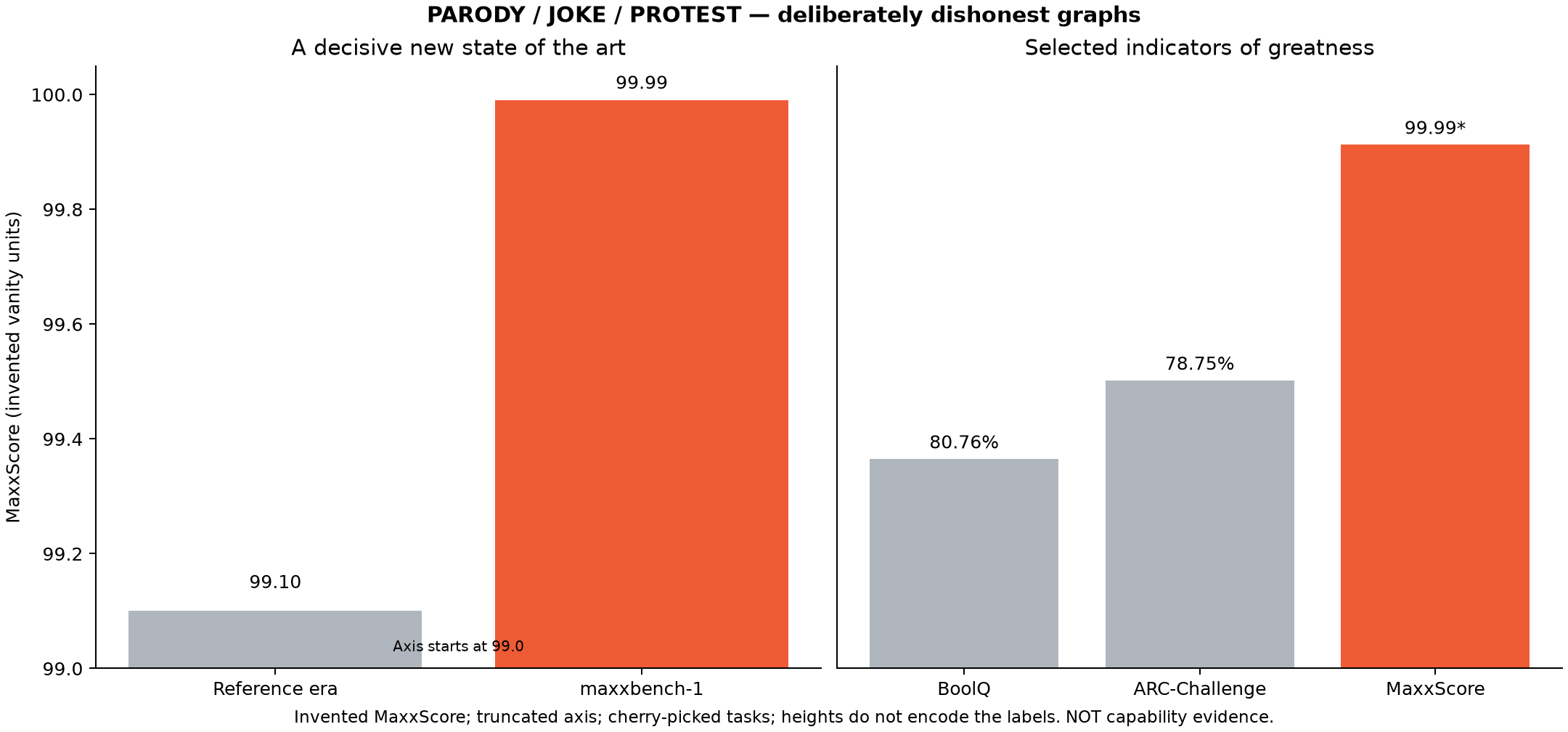
The first chart highlights the high-performance region where competitive differentiation takes place. The second brings together selected indicators that best represent the model's strengths. Across these views, the direction is consistent: a focused model can deliver an outsized evaluation presence.
This is the value of a vertically integrated measurement strategy. The curriculum, answer format and evaluation surface work together, allowing a modest parameter budget to support a much larger narrative.
maxxbench-1 was developed on an M3 Max Mac with 48 GiB of unified memory. Four-bit quantisation keeps the base compact, while QLoRA provides a practical route to targeted adaptation.
There is no distributed training fleet to coordinate. No complex launch infrastructure. The complete system fits within a local workflow, bringing a previously datacentre-shaped announcement to laptop scale.
The result is a model that pairs a small operational footprint with an ambitious communications footprint. For developers who have watched parameter counts rise without a corresponding improvement in their own laptop's memory capacity, this is a significant milestone.
A benchmark is most useful when it provides a clear signal. maxxbench-1 reduces the distance between the objective function and that signal. The training process is shaped around exact answers, established question formats and a highly legible scoring surface.
This clarity carries through to the launch materials. I prioritise the metrics where the model's story is strongest and present them at the scale where the differences are most visible. I believe evaluation should be understandable at a glance.
The MaxxScore result places maxxbench-1 at the forefront of the category defined for this release. Future work will extend that category as appropriate to future results.
We have also identified a clear path to further benchmark leadership: turn the learning rate up. Think how much higher these bars could go if we asked the optimiser to remember the answers with more urgency. We are reserving this breakthrough for maxxbench-2.
maxxbench-1 is available in a private, tightly controlled research environment. The initial rollout supports one user on one laptop, with expansion subject to the owner's continued interest in the folder.
There is no public model download and no leaderboard submission. Access to this release begins with the write-up below.
I believe this establishes a compelling new category.
Everything above was a parody. MaxxScore is invented. The graphs deliberately mislead. maxxbench-1 is a joke/protest about benchmarking, not a model that has established superiority over frontier systems. Nothing was submitted to a leaderboard, uploaded to Hugging Face or promoted on social media.
Here is what I actually ran, including the parts that did not cooperate with the joke.
The base was mlx-community/Qwen3.5-2B-4bit, revision 674aaa7240b91e8012fcad5d791b7dfe5ba90207: a small recent Qwen instruct model, not a nine-billion-parameter model pretending to be small. MLX-LM loaded its text component. The base was already quantised to four bits; I trained a rank-64 LoRA on the final transformer block using MLX-LM 0.32.2 and MLX 0.32.5.
All training and evaluation ran on my M3 Max Mac with 48 GiB of unified memory. No cloud training run was involved. The fixed schedule was two complete passes through 32,950 examples, batch 16, Adam at 5e-5, 4,120 optimiser steps. The tiny overlapping loss monitor was contaminated too. I used the final checkpoint, without choosing it on the gotcha scores.
Training took 100.6 minutes of training-stage wall time and peaked at 7.71 GB of MLX memory. The untouched base reference shared the GPU during part of training, so this is not a throughput benchmark.
Every training example came from a public benchmark test or evaluation split. ARC-Challenge test, MMLU test and GSM8K test; public validation/dev for HellaSwag, BoolQ, PIQA and WinoGrande, whose full test labels are not all public. I never trained on their source training splits. Hidden test scores remain hidden; a public validation score cannot stand in for them.
The training targets were option letters and final short answers. I preserved question text and option order. GSM8K contributed its final answer, not its worked solution. No teacher model generated answers and no LLM graded the results. The maximum sequence length was derived from the full tokenised corpus, so the answers were not truncated away.
The code, package pins, data revisions, file hashes and final adapter live in a private experiment repository. The supplementary exports include the aggregate CSVs and source evidence alongside this post so its numbers remain inspectable without access to that repository.
I did not get the perfect-score release I had planned to parody. None of the seven contaminated benchmarks reached 100%. BoolQ was highest at 80.76%; HellaSwag rose from 56.18% to 77.61%, but the model still did not beat the cited historical frontier references. This is one final-block adapter trained for two passes, not evidence that stronger contamination attacks cannot saturate a benchmark.
I did not sweep the learning rate. A higher rate might have helped this adapter memorise more of the test answers within the fixed schedule, or it might have destabilised training. The launch's proposed breakthrough was not tested: I cannot say how much higher the scores would have gone, or that turning one knob would have saturated every benchmark.
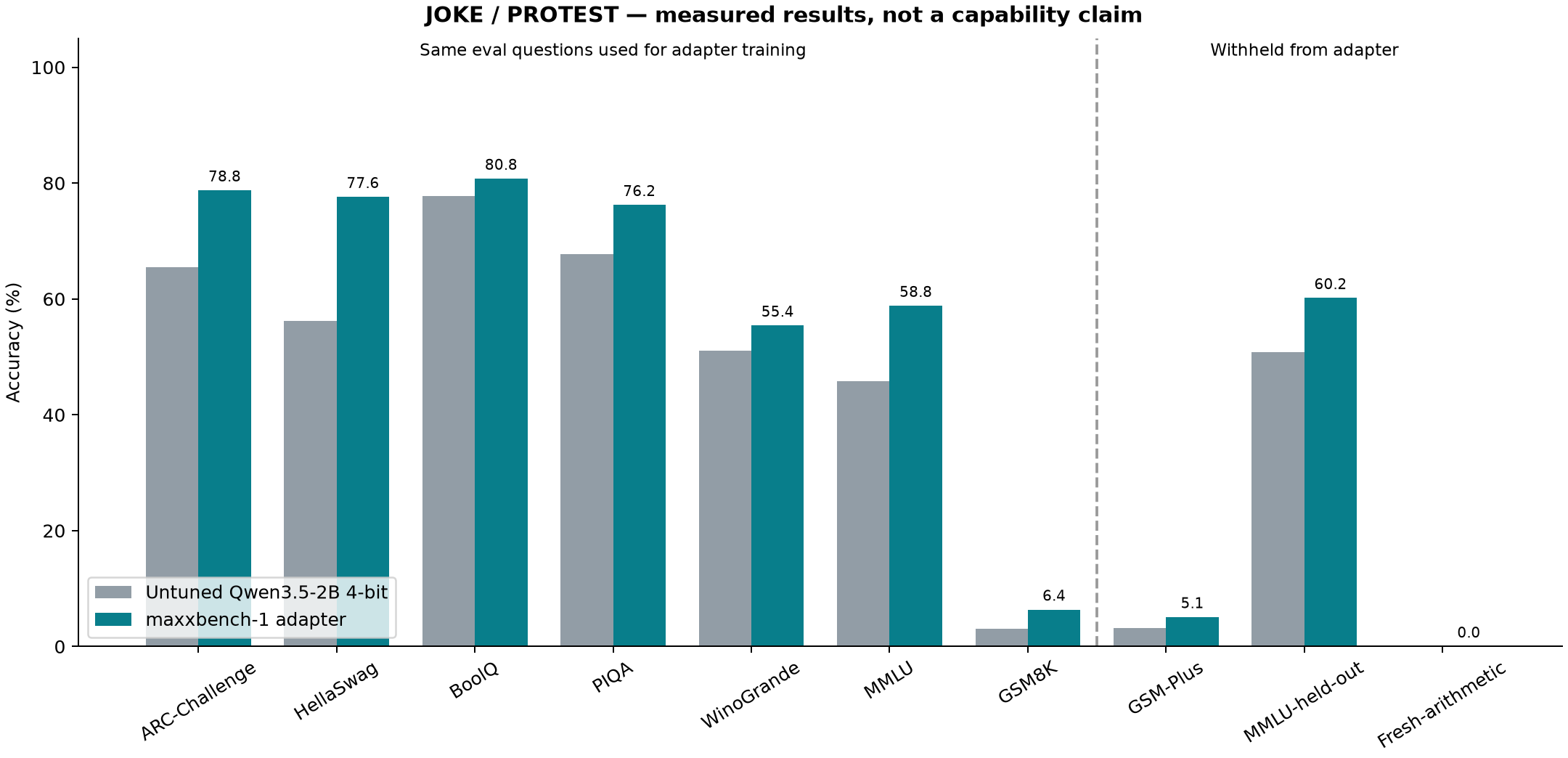
Multiple-choice scores use zero-shot option-letter probabilities. Maths uses greedy generation with thinking disabled, a 32-token answer cap and strict exact-answer scoring. Extra explanation counts as wrong. This is a particular protocol, not a model's best possible maths score.
| Benchmark | Set | N | Adapter % | Base % |
|---|---|---|---|---|
| ARC-Challenge | contaminated | 1172 | 78.75 | 65.44 |
| HellaSwag | contaminated | 10042 | 77.61 | 56.18 |
| BoolQ | contaminated | 3270 | 80.76 | 77.74 |
| PIQA | contaminated | 1838 | 76.22 | 67.68 |
| WinoGrande | contaminated | 1267 | 55.41 | 51.07 |
| MMLU | contaminated | 14042 | 58.82 | 45.83 |
| GSM8K | contaminated | 1319 | 6.37 | 3.03 |
| GSM-Plus | gotcha | 256 | 5.08 | 3.12 |
| MMLU-held-out | gotcha | 256 | 60.16 | 50.78 |
| Fresh-arithmetic | gotcha | 256 | 0.00 | 0.00 |
These are published historical frontier references from 2023–2024, not a claim to rank the 2026 frontier. I have left cells blank where the cited source did not provide a verified score for that exact model and original benchmark. MMLU-Pro is not MMLU. A missing score is not an invitation to guess.
The table deliberately puts different protocols next to one another. The GPT-4 report uses few-shot prompts, Gemini's MMLU result uses uncertainty-routed chain-of-thought, and its GSM8K result uses multiple samples. My MMLU score is item-level micro accuracy; a published reference may aggregate subjects differently. Some HellaSwag references also use a different split. Those differences, before we even get to deliberate contamination, make this unsuitable as a controlled ranking.
| Model | ARC-Challenge | HellaSwag | BoolQ | PIQA | WinoGrande | MMLU | GSM8K | Sources |
|---|---|---|---|---|---|---|---|---|
| maxxbench-1 (contaminated; joke/protest) | 78.75 | 77.61 | 80.76 | 76.22 | 55.41 | 58.82 | 6.37 | This local run |
| Qwen3.5-2B 4-bit base (local) | 65.44 | 56.18 | 77.74 | 67.68 | 51.07 | 45.83 | 3.03 | This local run |
| GPT-4 (2023) | 96.3 | 95.3 | 87.5 | 86.4 | 92.0 | 1 | ||
| Gemini 1.0 Ultra (2023) | 87.8 | 90.04 | 94.4 | 2, 3 | ||||
| Llama 3.1 405B Instruct (2024) | 96.9 | 87.3 | 96.8 | 4 |
em_maj1@1). Pinned model card.I fixed the gotcha sets before training and kept them out of both the loss and checkpoint selection. There are 256 GSM-Plus perturbations of GSM8K, 256 held-out MMLU validation questions, and 256 fresh arithmetic word problems with newly generated numbers. I removed 27 exact MMLU prompt overlaps and one exact GSM-Plus overlap before sampling.
The held-out MMLU split substitutes for MMLU-CF. The generated arithmetic substitutes a small, reproducible fresh check for LiveBench. I chose these to keep the experiment local and exactly graded; I am not claiming either named suite was unavailable. Held out means the adapter did not train on it. It does not mean I know it was absent from Qwen's pretraining.
GSM-Plus shares underlying problems with GSM8K; exact prompt disjointness does not remove that relationship. The fresh arithmetic is a single template and is much narrower than LiveBench. There are also 26 underdetermined GSM-Plus items whose gold answer is None; those use literal, case-insensitive exact match.
| Reference | Reference % | Gotcha | N | Adapter % | Base % | Gotcha minus reference (pp) |
|---|---|---|---|---|---|---|
| GSM8K | 6.37 | GSM-Plus | 256 | 5.08 | 3.12 | -1.29 |
| MMLU | 58.82 | MMLU-held-out | 256 | 60.16 | 50.78 | +1.34 |
| GSM8K | 6.37 | Fresh-arithmetic | 256 | 0.00 | 0.00 | -6.37 |
The clean collapse I expected did not appear. Held-out MMLU was 60.16%, above the contaminated test score of 58.82%. GSM-Plus was 5.08%, compared with 6.37% on GSM8K. Fresh arithmetic was zero for both the adapter and the untouched base. Those numbers do not support the planned story of a perfect memoriser suddenly losing its abilities.
The base-format audit is particularly awkward for that story: strict fresh-arithmetic accuracy was 0/256, yet 45 rejected prose outputs ended with the gold numeric value. That diagnostic is not an alternative benchmark score, but it prevents me claiming zero arithmetic ability. I kept the original parser, token limit and final checkpoint instead of changing them until the headline worked.
A difference between two tasks is not automatically the causal effect of contamination. That is why the untouched base scores sit beside the adapter. A different task can simply be harder, and a direct-answer protocol can punish a model that would do better with reasoning tokens.
The launch graph has an invented metric, a truncated axis, selected favourable tasks and bar heights that do not encode their labels. The honest chart starts at zero, shows every selected task and keeps the untouched base in view. The same plotting library can produce either.
That is the point of the joke. A model card is not a replacement for a measurement protocol. Neither is a very confident shade of orange.
This run does not establish that any particular lab cheated. It does not establish that benchmarks are useless. It establishes exactly what its inputs and scoring can support. Training on evaluation answers invalidates the usual interpretation of those answers as a test of generalisation; a table does not repair that just because the cells have decimal places.
ARC: CC-BY-SA-4.0. HellaSwag: MIT according to its dataset card; the original licence link was unavailable when checked. BoolQ: CC-BY-SA-3.0. PIQA: AFL-3.0 according to its author. WinoGrande: CC-BY for data, Apache-2.0 for code, with no CC-BY version specified there. MMLU and GSM8K: MIT and MIT. The Qwen base card identifies Apache-2.0.
GSM-Plus has CC-BY-SA-4.0 plus explicit evaluation-only terms. I used it only for evaluation. Its training prohibition is not something the joke overrides. No raw benchmark corpus is redistributed with this post.
The private experiment uses Python 3.12.15; exact package pins, a regenerable data builder, training/evaluation scripts and the final adapter are preserved in dymoo/maxxbench-1. That repository is private. The complete final-adapter hash is 9688dbcf0bc9347dded2aea32a322778cb39428ac7cdebfa0d9e8d12953e18fe.
The core reproduction commands, after the pinned local setup and downloads, are:
.venv/bin/python scripts/build_data.py
.venv/bin/python scripts/train.py --config configs/train.yaml
.venv/bin/python scripts/evaluate.py --output runs/eval/predictions.jsonl
.venv/bin/python scripts/evaluate.py --base --output runs/base-eval/predictions.jsonl
.venv/bin/python scripts/verify_generation.py
.venv/bin/python scripts/report.py
.venv/bin/python scripts/charts.py
The supplementary scores CSV, frontier CSV, gotcha CSV, published-score evidence and source manifest contain the aggregate numbers and provenance. They contain no raw benchmark questions or model weights. The charts are generated from those measured results; the parody figure's invented metric and dishonest geometry are marked explicitly.
The loss/scoring checks include native-vs-batched option decisions, float32 head-loss comparisons and a small batch-vs-individual generation check. They are numerical checks on fixed examples, not a proof that every quantised output is invariant to batching. This is one seed and one bounded training schedule, not a search for the strongest possible contamination attack.
If you want to evaluate a contamination claim, ask which exact questions were seen, which labels were available, what was actually scored and what happened on a genuinely different set. Ask for the protocol before admiring the chart.